Platform
Replication lets you choose what to replicate, background jobs recover from a worker crash, and the recorder fixes three recording and monitoring problems.
Selective call replication
Changed behavior for system administrators.
Replicate data on replication jobs and incoming tokens offers Call metadata, Audio files, Evaluation Reports, and Transcripts as separate choices, and evaluation reports replicate together with their calls. Incoming tokens gain Related data sync mode, which either merges replicated evaluation reports and transcripts with local records or replaces them with the source's set, and Assign replicated calls to local users and clients. Unchanged calls are not uploaded again in queue mode.
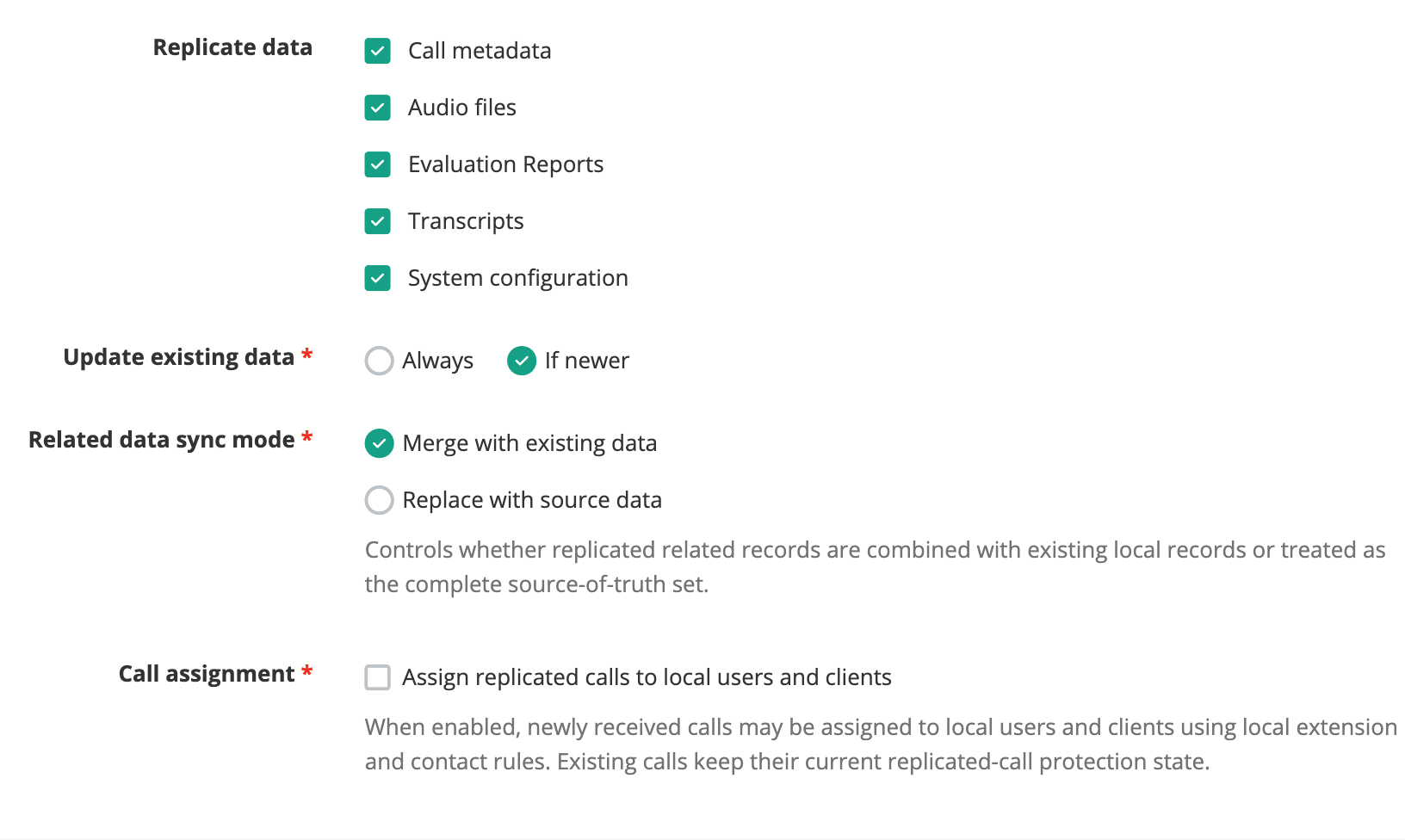
The Replicate data, Related data sync mode, and call assignment options of a token.
See Replication configuration.
Improvements
- Continuous queue-backed jobs restart after a worker dies mid-run instead of stalling until the result expires.
Fixes
- Recordings made with the SIPREC EarlyCreateFile option have the correct sample rate.
Recorder versions 2025.11.3 through 2025.12.2 wrote an 8 kHz header when the file was created
before the first RTP packet arrived, so calls that negotiated a wideband codec such as G.722
(16 kHz) played back at half speed. Only SIPREC calls with
EarlyCreateFile = true(the default isfalse) and a wideband codec were affected. Narrowband calls (G.711), other recording protocols, and the default SIPREC configuration recorded correctly. - Validation of recording announcement filters works on Linux recorders.
- Live monitoring sessions start on recorders whose system time zone is not UTC; a valid link was rejected as expired.
- Merge-mode replication keeps a local evaluation report when the incoming report is rejected by a restricted token.