User accounts
A user is any person with an account in MiaRec — agents whose conversations are captured and analyzed, supervisors who review them, and administrators. This page covers creating and managing user accounts. For the underlying concepts, see People & Access.
To manage users, go to Administration › User Management › Users.
The user list
The list shows every user your access scope covers, with their group, role, recording setting, and extension. You can:
- search by name, extension, group, or role, or filter the list by group;
- switch to the Advanced Search tab for filter-based searches;
- add a user (Add User), delete selected users (Delete User), or change settings on many users at once (Bulk Edit).
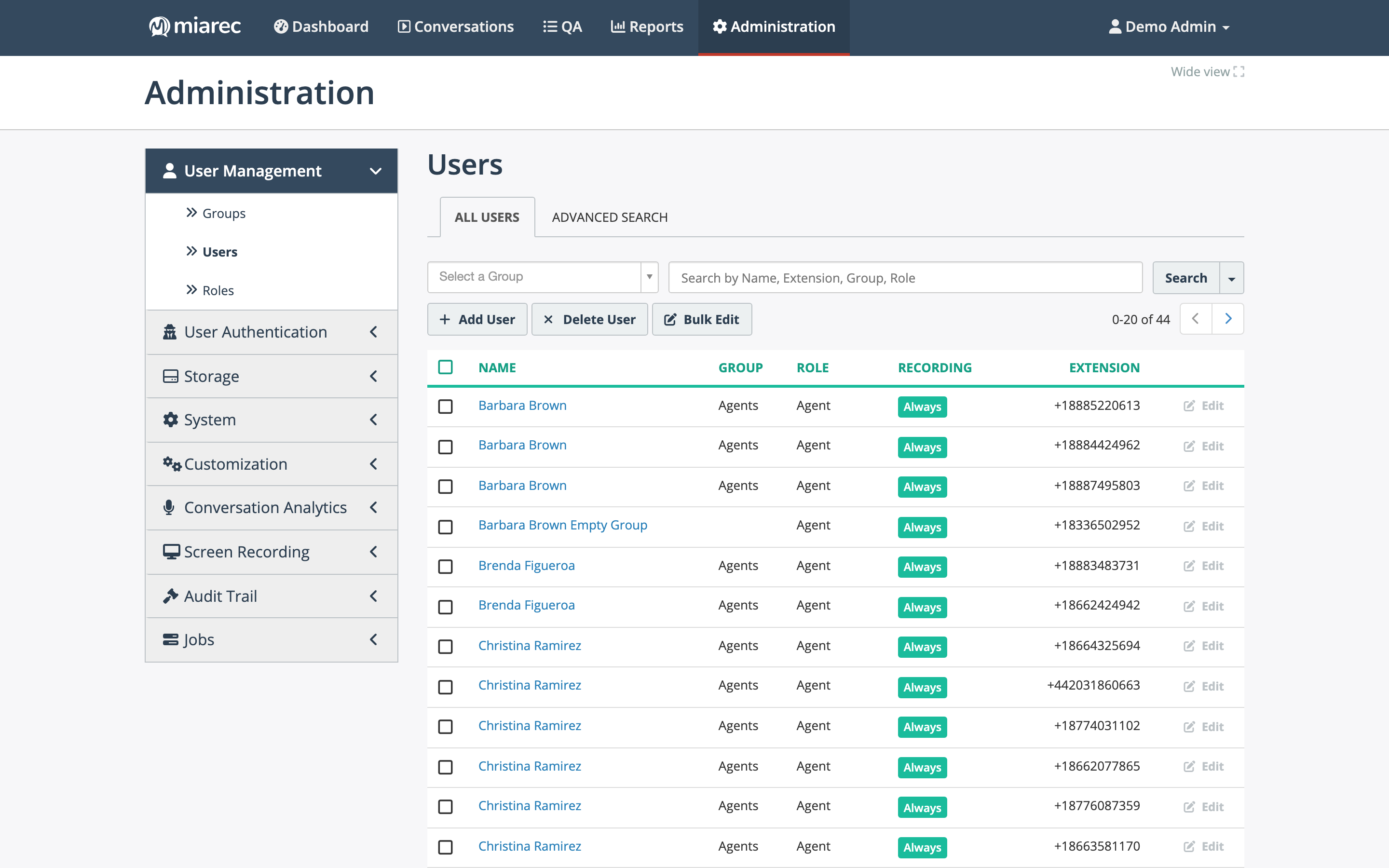
The Users list. Notice the group filter and the search box, and the Bulk Edit button — the fastest way to change roles, licenses, or capture settings for many users at once.
Click a user's name to open their profile. The profile has two tabs — User Info with all account settings, and Security (see Security tab) — plus the action buttons Edit User, Impersonate, Reset Password, and Delete User.
Creating and editing a user
Click Add User, or Edit User on an existing profile. The form groups settings into the sections described below.
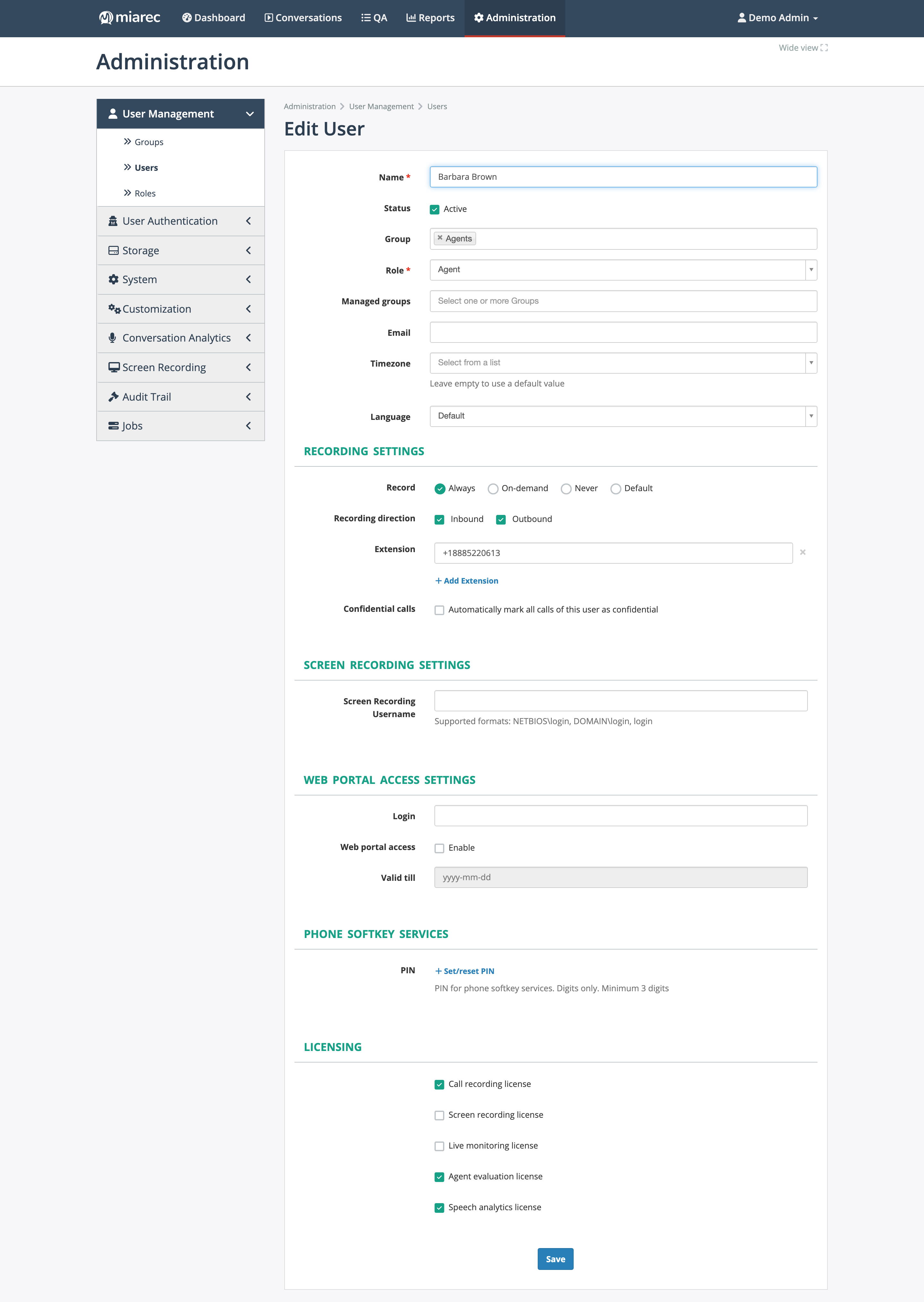
The Edit User form. Profile settings come first, followed by capture settings, web portal access, and per-user licenses.
Profile
- Name — the user's display name. Required.
- Status — whether the account is active. Inactive users cannot sign in and their conversations are no longer captured under this account.
- Group — the team the user belongs to (see Groups).
- Role — determines what the user can see and do (see Roles and permissions). Required.
- Managed groups — shown when the selected role has the Selected Groups access scope: choose the groups this user supervises. The user sees only the users and conversations of those groups.
- Email — used for notifications, password reset, and single sign-on account matching.
- Timezone and Language — leave empty to use the defaults (the group's timezone and the portal's default language).
Recording Settings (capture)
This section controls whether and how the user's conversations are captured: the recording mode (Always / On-demand / Never / Default), the recording direction, the user's extensions (the phone numbers that associate conversations with this user), and an option to automatically mark all of the user's conversations as confidential. A Screen Recording Username field associates desktop screen captures with the user, and a PIN can be set for phone softkey services.
These settings are summarized here because they live on the user form; how capture works — recording modes, extensions, and conversation-to-user association — is covered in the Ingestion chapter:
Web Portal Access Settings
Not every user needs to sign in — an agent's conversations can be captured and analyzed without web access. To let a user use the portal:
- Login — the sign-in name.
- Web portal access — enable to allow sign-in.
- Valid till — optionally expire the account on a date.
- Authentication — password or Single Sign-On (see Single sign-on). For password accounts you can require a password change at the next sign-in.
- 2-step verification — require two-step verification for this user's sign-ins (see Two-step verification).
Licensing
Some capabilities are licensed per user: assign a license to each user who needs the capability. The user form shows a checkbox for each license type:
- Call recording license — the user's conversations are captured.
- Speech analytics license — the user's conversations are transcribed and analyzed by AI (Conversation Analytics). Available if your subscription includes Conversation Analytics.
- Agent evaluation license — the user's conversations can be evaluated (QA). Available if your subscription includes Quality Assurance.
- Live monitoring license — the user's active conversations can be listened to in real time (see Live monitoring).
- Screen recording license — the user's desktop screen is captured during conversations (see Screen recording).
The number of licenses of each type available to your organization is set by your subscription — see Subscriptions & Licensing. License checkboxes are managed per user; use Bulk Edit on the user list to assign a license to many users at once.
Resetting a user's password
Open the user's profile and click Reset Password. Choose one of:
- Create a new password for the user — set the password yourself, optionally with Must change password on next login.
- Send a Welcome email to the user with a Create Password link — for new accounts.
- Send the user a Reset Password link by email — the user sets their own password. Requires the account to be active and to have an email address.
Organization-wide password rules and self-service reset are configured in Password policy.
Impersonating a user ("login as")
Impersonate on a user's profile signs you in to the portal as that user — useful for verifying what a user can see, or reproducing a problem they reported. By default you must confirm your own password first, and the impersonation is recorded in the audit trail. You cannot impersonate your own account, or accounts that are inactive or have no web portal access.
The Security tab
The Security tab of a user's profile shows the security state of the account:
- Linked Accounts — single sign-on accounts linked to this user (see Single sign-on).
- 2-Step Verification Methods — the verification methods the user has enrolled.
- Trusted devices and User devices — devices the user has signed in from.
- Users Web Sessions — the user's currently active sessions (see Web sessions for the organization-wide view).
Related pages
- Groups — organize users into teams.
- Roles and permissions — control what users can do.
- User reports — export user account details as a report.